
Table of Contents
- Quick Answer
- How Nattokinase Affects Blood Clotting
- Why Nattokinase and Blood Thinners Can Be a Risky Combination
- What the Research Says About Nattokinase Bleeding Risk
- Who Should Not Take Nattokinase
- How to Talk to Your Doctor About Nattokinase and Blood Thinners
- Nattokinase Contraindications: The Complete List
- For Those Not on Blood Thinners: What the Evidence Supports
- References
- FAQs
Nattokinase and Blood Thinners: What You Need to Know
Quick Answer
Nattokinase and blood thinners should not be combined without medical supervision.
- Nattokinase has its own fibrinolytic (clot-dissolving) and anticoagulant activity
- Combining nattokinase and blood thinners like warfarin or heparin may increase bleeding risk
- People already on anticoagulant therapy should consult their physician before supplementing
- For those not on blood thinners, nattokinase at 10,800 FU/day has a strong safety profile (Chen et al., 2022)
One of the most common questions about nattokinase supplementation is whether it's safe to take alongside blood thinners. It's a fair question — nattokinase and blood thinners both affect the body's clotting system, and the consequences of getting it wrong can be serious.
This article explains exactly how nattokinase interacts with anticoagulant medications, who should not take nattokinase, what the clinical research shows about nattokinase bleeding risk, and how to have an informed conversation with your doctor about nattokinase and blood thinners.
Related reading: What Is Nattokinase? Benefits, Dosage, Side Effects, and How to Use It
How Nattokinase Affects Blood Clotting
To understand why nattokinase and blood thinners interact, you need to understand how nattokinase works in the body. Unlike most supplements, nattokinase is a serine protease enzyme with direct physiological effects on the coagulation system.
Nattokinase works through two complementary mechanisms:
- Direct fibrinolysis: Nattokinase directly breaks down fibrin, the structural protein that forms the mesh of blood clots. This is its primary mechanism — it physically degrades existing fibrin strands. (Chen et al., 2018)
- Plasminogen activation: Nattokinase also converts plasminogen to plasmin, the body's own clot-dissolving enzyme. This amplifies the fibrinolytic effect beyond what nattokinase does alone.
Nattokinase operates through a dual mechanism: direct fibrin cleavage and plasminogen activation. This dual pathway gives nattokinase its potent fibrinolytic activity, which is why combining nattokinase and blood thinners requires medical supervision.
Additionally, clinical research has demonstrated that nattokinase decreases plasma levels of fibrinogen, factor VII, and factor VIII — key proteins in the clotting cascade (Hsia et al., 2009). These are the same markers that physicians monitor when managing patients on anticoagulant therapy.
Related reading: How Nattokinase Works: The Science Behind the Enzyme
Why Nattokinase and Blood Thinners Can Be a Risky Combination
Blood thinners (anticoagulants) work by inhibiting various parts of the clotting process. When you add nattokinase — which has its own anticoagulant and fibrinolytic properties — the combined effect may be stronger than either one alone. This is why nattokinase and blood thinners together raise safety concerns.
Here's how the most common blood thinners overlap with nattokinase's mechanisms:
| Blood Thinner | How It Works | Potential Nattokinase Interaction |
|---|---|---|
| Warfarin (Coumadin) | Blocks vitamin K-dependent clotting factors | Nattokinase reduces the same clotting factors (VII, VIII), potentially amplifying warfarin's effect |
| Heparin | Enhances antithrombin activity | Combined with nattokinase's fibrinolysis, may increase bleeding risk |
| Aspirin | Inhibits platelet aggregation | Nattokinase works on fibrin rather than platelets, but combined anticoagulant load increases risk |
| Clopidogrel (Plavix) | Blocks platelet activation | Similar concern — additive anticoagulant effects |
| Rivaroxaban (Xarelto) | Direct factor Xa inhibitor | Nattokinase's factor VII/VIII reduction may compound the anticoagulant effect |
| Apixaban (Eliquis) | Direct factor Xa inhibitor | Same concern as rivaroxaban |
The core issue is additive anticoagulation. Each of these medications already shifts the body's clotting balance. Nattokinase shifts it further in the same direction. The result can be an increased nattokinase bleeding risk that neither your doctor nor your supplement label accounted for.
Taking nattokinase and blood thinners together creates additive anticoagulant effects that may increase bleeding risk beyond what either agent produces alone. Always consult your physician before combining them.
Related reading: Nattokinase Side Effects and Considerations
What the Research Says About Nattokinase Bleeding Risk
The clinical evidence on nattokinase bleeding risk comes primarily from studies of nattokinase used alone — not in combination with blood thinners. This distinction matters.
Nattokinase Alone Has a Strong Safety Profile
In the landmark Chen et al., 2022 study — 1,062 participants taking 10,800 FU per day for 12 months — no serious adverse events were reported. This is the largest nattokinase safety dataset available.
Kurosawa et al., 2015 confirmed that a single dose of nattokinase at 10,800 FU enhanced fibrinolytic activity and demonstrated anti-coagulation effects in healthy volunteers, without adverse events.
Hsia et al., 2009 showed that nattokinase decreased fibrinogen, factor VII, and factor VIII over 8 weeks in 45 participants — significant clotting factor reductions — but no bleeding events were reported.
Clinical studies on nattokinase have demonstrated a strong safety profile with no serious adverse events reported at dosages up to 10,800 FU per day, though these studies excluded participants on anticoagulant medications.
The Gap: No Large Studies on Nattokinase Plus Blood Thinners
Here's the critical caveat: major clinical studies on nattokinase systematically excluded participants on anticoagulant therapy. This means we have strong evidence that nattokinase is safe on its own, but limited evidence on what happens when nattokinase and blood thinners are combined.
Case reports in the medical literature have documented instances of increased bleeding in patients who combined nattokinase with warfarin without medical supervision. While case reports aren't the same as controlled studies, they reinforce the caution.
The absence of evidence is not evidence of absence. Until large-scale studies specifically examine nattokinase and blood thinners together, the medical consensus is to avoid unsupervised combination.
Related reading: Nattokinase Dangers? Separating Fact from Fiction
Who Should Not Take Nattokinase
Based on current clinical evidence and medical guidelines, the following groups should not take nattokinase without explicit physician approval:
1. People on Anticoagulant Medications
If you take warfarin, heparin, rivaroxaban, apixaban, dabigatran, or any other blood thinner, nattokinase and blood thinners together may create dangerous anticoagulant overlap. Your physician manages your anticoagulation carefully — adding nattokinase without their knowledge can disrupt that balance.
2. People on Antiplatelet Therapy
If you take aspirin, clopidogrel (Plavix), or other antiplatelet medications, the same caution applies. While nattokinase works through different mechanisms than antiplatelet drugs, the additive effect on clot prevention may increase nattokinase bleeding risk.
3. People With Bleeding Disorders
Conditions like hemophilia, von Willebrand disease, or other coagulopathies already impair clot formation. Adding a fibrinolytic enzyme like nattokinase could worsen bleeding tendency.
4. People Scheduled for Surgery
Nattokinase should be discontinued at least two weeks before any scheduled surgical procedure. Its fibrinolytic effects can persist for several days after the last dose, and surgeons need your clotting system to function normally during and after the procedure.
5. Pregnant or Nursing Women
There is insufficient safety data on nattokinase during pregnancy or lactation. Until this data exists, nattokinase supplementation is not recommended for these populations.
Who should not take nattokinase: anyone on blood thinners, antiplatelet medications, or with bleeding disorders — unless explicitly cleared by their physician. Surgery patients should stop nattokinase at least two weeks prior.
Related reading: Nattokinase for Blood Clots: Can It Really Dissolve Existing Clots?
How to Talk to Your Doctor About Nattokinase and Blood Thinners
If you're currently on blood thinners and interested in nattokinase, the conversation with your doctor should cover these specific points:
What to Tell Your Doctor
- What nattokinase is: A fibrinolytic enzyme derived from fermented soybeans (or chickpeas), with clinical evidence for clot-dissolving and lipid-lowering effects
- The dose you're considering: The clinically studied dose is 10,800 FU per day (Chen et al., 2022)
- The specific mechanisms: Direct fibrin degradation plus plasminogen activation, plus reduction of clotting factors VII and VIII
- Your motivation: Whether you're interested in cardiovascular protection, cholesterol support, blood pressure, or another specific benefit
What to Ask Your Doctor
- Could nattokinase be an alternative to my current medication, or only a complement?
- Would my INR or other clotting markers need to be monitored more frequently?
- Are there specific blood tests that could help assess the safety of combining nattokinase and blood thinners in my case?
- What signs of excess anticoagulation should I watch for?
For People Not on Blood Thinners
If you're not currently on anticoagulant or antiplatelet therapy, the safety picture is much clearer. The Chen 2022 study's 1,062 participants took 10,800 FU daily for a full year with no serious side effects. This is a robust safety dataset that supports supplementation at the clinical dose.
Related reading: Nattokinase Dosage Guide: Why 2,000 FU May Not Be Enough
Nattokinase Contraindications: The Complete List
Beyond the nattokinase and blood thinners interaction, here is the full list of nattokinase contraindications based on current evidence:
| Contraindication | Reason | Action |
|---|---|---|
| Anticoagulant medications (warfarin, heparin, DOACs) | Additive anticoagulant effects, increased bleeding risk | Do not take without physician approval |
| Antiplatelet drugs (aspirin, clopidogrel) | Additive anti-clotting effects | Consult physician before use |
| Bleeding disorders | Impaired clot formation + fibrinolytic enzyme = risk | Avoid nattokinase |
| Scheduled surgery (within 2 weeks) | Fibrinolytic effects may impair surgical hemostasis | Discontinue 14 days before surgery |
| Pregnancy / nursing | Insufficient safety data | Avoid until evidence exists |
| Severe hypotension | Nattokinase may reduce blood pressure further (Kim et al., 2008) | Consult physician |
| Active bleeding | Fibrinolytic enzyme would worsen bleeding | Do not take |
Nattokinase contraindications include concurrent use of anticoagulants, bleeding disorders, upcoming surgery, pregnancy, and active bleeding. When in doubt, consult your healthcare provider.
For Those Not on Blood Thinners: What the Evidence Supports
If nattokinase and blood thinners don't apply to your situation — meaning you're not on anticoagulant therapy — the clinical evidence strongly supports nattokinase supplementation at the right dose.
The Chen et al., 2022 study found that 10,800 FU per day, co-administered with Vitamin K2 (180 mcg/day), significantly reduced atherosclerosis and improved lipid profiles over 12 months. A lower dose of 3,600 FU per day was ineffective, demonstrating a clear dose-response relationship.
Additional clinical evidence shows:
- Blood pressure: 5.55 mmHg systolic reduction (Kim et al., 2008)
- Plaque reduction: 36.6% reduction in carotid plaque size (Ren et al., 2017)
- Clotting factor reduction: Significant decreases in fibrinogen, factor VII, and factor VIII (Hsia et al., 2009)
- Fibrinolytic activity: Enhanced clot-dissolving capacity confirmed at 10,800 FU (Kurosawa et al., 2015)
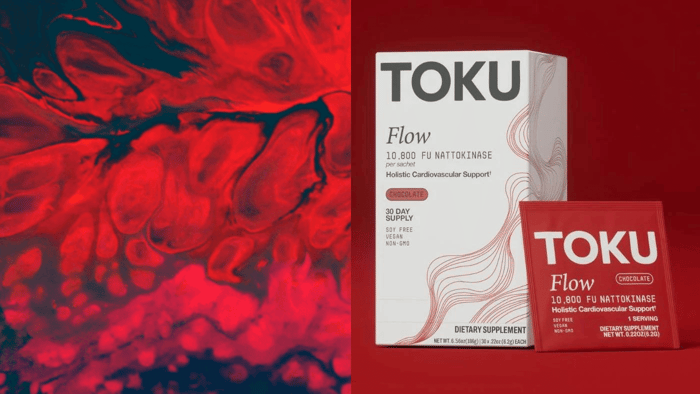
Key finding: Toku Flow replicates the exact Chen et al. 2022 protocol — 10,800 FU nattokinase co-administered with 180 mcg Vitamin K2 (MK-7) daily — the combination shown effective in 1,062 participants over 12 months (Chen et al., 2022).
Toku Flow 10,800 FU Nattokinase Supplement | Soy Free Powder

$179.97
High-Potency Nattokinase Supplement for Cardiovascular Health & CirculationToku Flow delivers 10,800 FU of clinical-grade nattokinase per daily sachet, paired with Vitamin K2 (MK-7) and oat beta-glucan for comprehensive cardiovascular support. Sourced from chickpea fermentation (soy-free), third-party tested, no fillers.… read more
FAQs
Can you take nattokinase and blood thinners together?
Nattokinase and blood thinners should not be combined without medical supervision. Nattokinase has its own fibrinolytic and anticoagulant properties that can amplify the effects of medications like warfarin, heparin, and DOACs, increasing bleeding risk. Always consult your physician before combining them.
Who should not take nattokinase?
People on blood thinners (warfarin, heparin, rivaroxaban, apixaban), antiplatelet drugs (aspirin, clopidogrel), those with bleeding disorders, anyone within two weeks of surgery, and pregnant or nursing women should not take nattokinase without physician approval.
What are the nattokinase contraindications?
Nattokinase contraindications include concurrent anticoagulant or antiplatelet therapy, bleeding disorders, upcoming surgery (within 14 days), pregnancy, nursing, severe hypotension, and active bleeding. These reflect nattokinase's fibrinolytic mechanism, which enhances clot breakdown.
Does nattokinase increase bleeding risk?
When taken alone at studied doses (up to 10,800 FU/day), nattokinase has a strong safety profile with no serious bleeding events in clinical trials involving over 1,000 participants. However, nattokinase does reduce clotting factors and enhance fibrinolysis, so it may increase bleeding risk when combined with anticoagulant medications.
Can nattokinase replace blood thinners?
Nattokinase has not been studied as a direct replacement for prescription blood thinners. While it has demonstrated fibrinolytic and anticoagulant effects in clinical studies, it has not undergone the regulatory trials required to be prescribed as an anticoagulant medication. Never stop taking prescribed blood thinners in favor of nattokinase without your doctor's explicit guidance.
How long before surgery should I stop nattokinase?
Most healthcare practitioners recommend discontinuing nattokinase at least two weeks (14 days) before any scheduled surgical procedure. Nattokinase's fibrinolytic effects can take several days to fully clear, and surgeons need your clotting system to function normally during and after the procedure.
Is nattokinase safe if I'm not on blood thinners?
Yes. For people not on anticoagulant or antiplatelet therapy, nattokinase at 10,800 FU per day has a strong safety record. The largest clinical study (1,062 participants, 12 months) reported no serious adverse events at this dose. As with any supplement, consult your healthcare provider before starting.
What is the clinically effective dose of nattokinase?
The clinically effective dose is 10,800 FU (fibrinolytic units) per day, based on the largest nattokinase study to date (1,062 participants, 12 months). This study found 10,800 FU effective for reducing atherosclerosis and improving lipid profiles, while 3,600 FU per day was ineffective.
Related reading: The 8 Incredible Nattokinase Benefits
References
- Chen H, McGowan EM, Ren N, et al. Nattokinase: A Promising Alternative in Prevention and Treatment of Cardiovascular Diseases. Biomarker Insights. 2018;13:1177271918785130.
- Chen H, Chen J, Zhang F, et al. Effective management of atherosclerosis progress and hyperlipidemia with nattokinase: A clinical study with 1,062 participants. Frontiers in Cardiovascular Medicine. 2022;9:964977.
- Hsia CH, Shen MC, Lin JS, et al. Nattokinase decreases plasma levels of fibrinogen, factor VII, and factor VIII in human subjects. Nutrition Research. 2009;29(3):190-196.
- Jensen GS, Lenninger M, Ero MP, Benson KF. Consumption of nattokinase is associated with reduced blood pressure and von Willebrand factor. Integrated Blood Pressure Control. 2016;9:95-104.
- Kim JY, Gum SN, Paik JK, et al. Effects of nattokinase on blood pressure: a randomized, controlled trial. Hypertension Research. 2008;31(8):1583-1588.
- Kurosawa Y, Nirengi S, Homma T, et al. A single-dose of oral nattokinase potentiates thrombolysis and anti-coagulation profiles. Scientific Reports. 2015;5:11601.
- Ren NN, Chen HJ, Li Y, et al. A clinical study on the effect of nattokinase on carotid artery atherosclerosis and hyperlipidaemia. Zhonghua Yi Xue Za Zhi. 2017;97(26):2038-2042.
- Sumi H, Hamada H, Tsushima H, et al. A novel fibrinolytic enzyme (nattokinase) in the vegetable cheese Natto. Experientia. 1987;43(10):1110-1111.