
Table of Contents
- What Does Nattokinase Do? A Beginner's Guide to Benefits, Uses, and Safety
- What Is Nattokinase?
- What Does Nattokinase Do for Blood Clots and Circulation?
- What Does Nattokinase Do for Blood Pressure?
- What Does Nattokinase Do for Heart Health and Cholesterol?
- What Does Nattokinase Do Beyond the Heart?
- What Are the Side Effects and Safety Considerations?
- What to Know Before Trying Nattokinase
- Sources
- FAQs
What Does Nattokinase Do? A Beginner's Guide to Benefits, Uses, and Safety
If you have been researching natural supplements for heart and circulatory health, you may have come across the term nattokinase. So what does nattokinase do, exactly? In simple terms, nattokinase is a natural enzyme extracted from a traditional Japanese fermented food called natto, and it has been studied for its potential effects on blood clotting, circulation, blood pressure, cholesterol, and more. This guide covers the basics of what nattokinase is, what the research says it may do in the body, and what you should know before considering it as a supplement.
What Is Nattokinase?
Nattokinase is an enzyme — a type of protein that speeds up chemical processes in the body — that is produced during the fermentation of soybeans to make natto. Natto is a traditional Japanese food with a sticky texture and a strong flavor that has been consumed for centuries. The enzyme itself is not found in other soy products; it is uniquely produced through the specific fermentation process using the bacterium Bacillus subtilis (more on natto vs nattokinase).
Nattokinase was first identified in 1987 by researcher Dr. Hiroyuki Sumi, who discovered that natto contained a substance capable of dissolving blood clots. Since then, research has expanded significantly, and nattokinase supplements are now available worldwide, typically measured in fibrinolytic units (FU). Natto consumption has long been associated with longevity in Japan, and research has linked high natto intake to a reduced risk of death from cardiovascular disease.
What Does Nattokinase Do for Blood Clots and Circulation?
The most studied and well-established function of nattokinase is its ability to break down blood clots. The term for this is fibrinolytic activity — meaning it can dissolve fibrin, the protein that forms the structural mesh of a blood clot. This is the core reason nattokinase has attracted so much interest from cardiovascular researchers.
Nattokinase works through several mechanisms to support healthy blood flow. It directly breaks down fibrin, activates the body's own clot-dissolving enzymes, and reduces levels of a substance called plasminogen activator inhibitor-1, which normally suppresses the body's ability to dissolve clots on its own. According to a review published in Cardiovascular Therapeutics, nattokinase was found to be four times more potent than plasmin — the body's natural clot-dissolving enzyme — in animal studies. Human studies have also shown fibrinolytic effects following single oral doses.
One area of particular interest is the prevention of deep vein thrombosis (DVT), a type of blood clot that typically forms in the leg. A clinical trial found that a supplement combining nattokinase and pycnogenol reduced the risk of blood clots in the legs during long-haul flights. Researchers have also explored nattokinase as an adjunct therapy for stroke recovery, with preliminary data suggesting potential benefit in improving blood flow after cerebrovascular events (more on nattokinase benefits).
What Does Nattokinase Do for Blood Pressure?
Another area where nattokinase has shown consistent results in research is blood pressure. Multiple human studies have found associations between nattokinase supplementation and reductions in both systolic and diastolic blood pressure.
A systematic review and meta-analysis published in Reviews in Cardiovascular Medicine pooled data from six randomized controlled trials involving 546 participants and found that nattokinase supplementation was associated with meaningful reductions in blood pressure regardless of dose. A randomized, double-blind, placebo-controlled trial also found that nattokinase reduced blood pressure in people with prehypertension after 8 weeks of supplementation.
Researchers believe nattokinase may lower blood pressure partly by cleaving plasma fibrinogen after it is absorbed in the small intestine, and partly because its breakdown products have been shown to inhibit angiotensin-converting enzyme (ACE), which plays a role in constricting blood vessels. Some studies have also noted that these effects may be more pronounced in men than in women, though research in this area is still developing.
What Does Nattokinase Do for Heart Health and Cholesterol?
Beyond clots and blood pressure, research has investigated what nattokinase does for broader cardiovascular health, including its effects on cholesterol and arterial plaque. The findings here are promising but more complex, with dose appearing to be a key variable.
A large clinical study involving 1,062 participants found that nattokinase taken at a dose of 10,800 FU per day over 12 months was associated with significant reductions in total cholesterol, LDL cholesterol, and triglycerides, as well as a measurable reduction in arterial plaque size as measured by ultrasound. At a lower dose of 3,600 FU per day, no significant effects on lipid levels or plaque were observed. This suggests that for cholesterol and atherosclerosis-related outcomes, dose matters considerably.
A 2025 review published in Nutrients outlined several proposed mechanisms by which nattokinase may support lipid metabolism, including activating enzymes that break down triglycerides, enhancing lipoprotein lipase activity, and potentially inhibiting key enzymes involved in cholesterol production. It also noted anti-inflammatory and antioxidant properties that may indirectly support healthier blood vessel function. That said, the exact pathways remain an active area of research and have not been fully confirmed in human studies (more on supplements for heart health).
What Does Nattokinase Do Beyond the Heart?
Research into what nattokinase does has begun to extend beyond cardiovascular health. Animal studies have suggested that nattokinase may be capable of degrading amyloid fibrils, the abnormal protein deposits associated with Alzheimer's disease. A review published in MDPI Fermentation highlighted these emerging findings, noting potential neuroprotective properties including protective effects against cell death mechanisms associated with neurological disease. However, no human clinical trials have yet been conducted in this area, so these findings remain preliminary.
Some research has also explored nattokinase in the context of stroke recovery and cognitive outcomes, with early signals suggesting modest benefit in cognitive measures over a 12-month follow-up period in patients who had experienced stroke or transient ischemic attack. More large-scale, controlled research is needed before any conclusions can be drawn in this area.
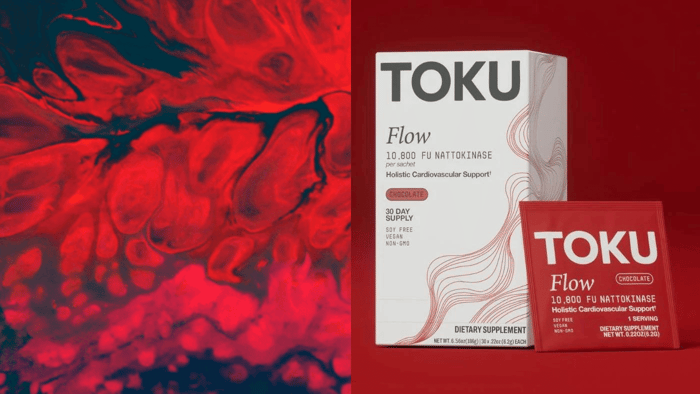
Toku Flow | Nattokinase Supplement (10,800 FU)

$179.97
High-Potency Nattokinase Supplement for Cardiovascular Health & CirculationToku Flow delivers 10,800 FU of clinical-grade nattokinase per daily sachet, paired with Vitamin K2 (MK-7) and oat beta-glucan for comprehensive cardiovascular support. Sourced from chickpea fermentation (soy-free), third-party tested, no fillers.… read more
What Are the Side Effects and Safety Considerations?
For most healthy adults, nattokinase appears to be well tolerated. A review of its safety profile published in Cardiovascular Therapeutics noted that no adverse effects were observed in human volunteers taking nattokinase at standard doses for up to four weeks in formal toxicology studies, and no mutagenic or toxic effects were found in animal studies even at doses 100 times higher than typical human use.
However, because nattokinase thins the blood, there are several important safety considerations every potential user should be aware of. People who take blood-thinning medications — including warfarin, aspirin, heparin, clopidogrel, or NSAIDs like ibuprofen — should not take nattokinase without first consulting a doctor, as the combination may increase the risk of excessive bleeding or bruising. People scheduled for surgery should consider stopping nattokinase supplementation at least two weeks beforehand. Nattokinase is not recommended for children, or for women who are pregnant or breastfeeding, due to limited safety data in those groups. Anyone with a soy or fermented soybean allergy should also avoid nattokinase supplements, as allergic reactions have been reported (our nattokinase supplement is made with fermented chickpeas).
It is also worth noting that, as with all dietary supplements, nattokinase products are not regulated with the same rigor as prescription medications, and quality can vary between brands.
What to Know Before Trying Nattokinase
The research on nattokinase is encouraging, particularly for those interested in natural approaches to supporting cardiovascular health. Its fibrinolytic and blood pressure-lowering effects have the most consistent support in human studies, while its effects on cholesterol and arterial plaque appear to require higher doses and longer supplementation periods. Its potential roles in neurological health are interesting but remain in early stages.
Before starting any new supplement, including nattokinase, consulting with a qualified healthcare professional is the most important step — particularly for anyone with existing health conditions or who takes prescription medications.
Sources
Nattokinase: A Promising Alternative in Prevention and Treatment of Cardiovascular Diseases
Nattokinase: A Promising Alternative in Prevention and Treatment of Cardiovascular Diseases
FAQs
What does nattokinase do?
Nattokinase is a natural enzyme derived from a fermented Japanese food called natto. It is best known for its ability to break down blood clots, support healthy circulation, and reduce the risk of clot-related conditions like deep vein thrombosis
Can nattokinase lower blood pressure?
Yes. Multiple human studies have found that nattokinase supplementation is associated with reductions in both systolic and diastolic blood pressure, believed to be due to its ability to inhibit ACE, an enzyme that causes blood vessels to constrict.
Does nattokinase help with cholesterol?
It may, but dose matters. Research found that higher doses (10,800 FU/day) over 12 months led to significant reductions in LDL, total cholesterol, triglycerides, and even arterial plaque, while lower doses showed no notable effect on lipid levels.
Is nattokinase safe to take?
For most healthy adults, yes. However, because it thins the blood, it should not be taken alongside blood-thinning medications like warfarin or aspirin without medical supervision.